
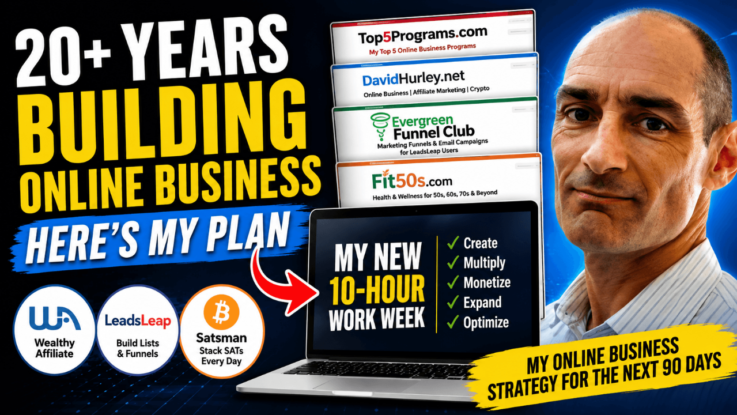
I’ve been building businesses online for more than 20 years.
When I came back to Japan in 1999, I already had an idea for a side business. I would sell Japanese games and related products to people overseas. I started with things like mahjong sets, Hanafuda cards, shogi sets and pieces, and eventually Japanese manga, Pilot pens and all sorts of other things people asked me to find for them.
To my surprise, it worked.
What started as a small website developed into quite a nice little business, and I continued selling physical products for roughly 16 years.
But there was an obvious limitation. There are only so many mahjong sets you can buy, pack and carry down to the post office. I could increase sales, but I couldn’t easily scale the business without increasing the physical work involved.
So, around 2006, I began looking seriously at other possibilities, and in 2007 I started experimenting with affiliate marketing.
It wasn’t an immediate success. In fact, I lost money at first.
But I was fortunate because the physical-products business was still generating income while I was learning about affiliate marketing. That gave me the breathing space to experiment, make mistakes and gradually develop a different kind of online business.
By 2016, I had completely wound down the physical side of the business. Since then, my focus has been on affiliate marketing, content, email marketing, websites and various online business opportunities.
And that brings me to where I am today.
n the video below, I take a look at how all these different pieces of my online business have developed, why I ended up with several different websites and projects, and the new 10-hour-per-week schedule I’ve created to bring everything together.
Watch the video: How I’m Bringing My Online Business Under Control
The problem with having an online business for 20 years
The interesting thing about looking back over more than 20 years of online business is that things accumulate. You discover a new idea. You build a website. You find an interesting affiliate program. You promote it. A new opportunity comes along, and you try that too.
Sometimes the program disappears. Sometimes you lose interest. Sometimes it turns out to be something worth keeping.
And gradually, if you’re not careful, you end up with a collection of websites, programs, mailing lists and projects which don’t necessarily have a clear relationship with one another.
That’s more or less where I found myself.
I currently have four main WordPress websites, as well as my YouTube channels and my activities on the Hive blockchain and with Satsman.
None of these things is necessarily a problem in itself. The problem is deciding how much time each one deserves.
So I decided that what I really needed wasn’t another business opportunity.
I needed a business audit.
Not a financial audit. I simply wanted to look at what I am actually doing with my time and decide what deserves my attention.
The result is a new 10-hour-per-week schedule.
I’ve decided to keep weekends completely free. That gives me some flexibility to catch up during a busy week, or to put in some extra time when I actually want to.
The idea is to work roughly two hours a day from Monday to Friday.
And this article, together with the video above, is the first step in that experiment.
My four main websites
The first part of the exercise was simply to look at the assets I already have.
Top5Programs.com
I started Top5Programs.com in 2017 because I was getting frustrated with the constant churn in affiliate marketing.
One month there would be an exciting new program. Everyone would be talking about it. A few months later, it might have disappeared.
I was part of that process myself. I’d jump from one opportunity to another.
So I decided to try something different: identify the programs that had demonstrated that they were reliable, useful and capable of becoming long-term parts of an online business.
That’s where the idea of my “Top 5” came from.
The list has changed over the years, but some programs have remained remarkably consistent. Wealthy Affiliate and LeadsLeap, for example, have been important parts of my business for years.
I’ve also added Prosperity Marketing System and Traffic Zipper, and more recently my own business, the Evergreen Funnel Club.
Top5Programs is therefore deliberately focused on a relatively small collection of business-to-business programs and services rather than trying to cover every shiny new opportunity that appears.
DavidHurley.net
DavidHurley.net is much more general.
This is where I can write about the things that don’t necessarily fit neatly into the Top 5 concept.
That includes affiliate marketing, traffic generation, online business experiments, crypto, Hive, Satsman and other things I’m interested in.
It has become something of a record of what I’m doing online.
And that’s actually useful because it gives me somewhere to document experiments rather than trying to make every website fit a particular commercial purpose.
Evergreen Funnel Club
Then there’s my Evergreen Funnel Club, which is my own business.
The basic idea is quite simple. I use LeadsLeap to build mailing lists and marketing funnels, and I create funnels and email follow-up campaigns that other LeadsLeap users can use.
One part of the service is creating funnels around useful new products and launches, particularly products appearing on WarriorPlus.
When I find something worthwhile, I can create the funnel, write the follow-up sequence and make the campaign available to my members.
They can then use the share code to bring the funnel and emails into their own LeadsLeap account, rebrand them and start promoting.
That means the work I do creating a campaign can potentially benefit both my own business and the members of Evergreen Funnel Club.
And that’s one of the areas I want to develop more systematically.
Fit50s
Fit50s.com is the fourth site in my portfolio.

I originally created it to provide useful information about healthy ageing and to introduce people to products and business opportunities I considered relevant to that demographic.
I looked at the site while doing this audit and realised that I hadn’t really done anything with it for around six months.
But I don’t see that as a reason to abandon it. Quite the opposite. I already have the website, the content, the YouTube channel and a clear audience in mind. What it needs now is a fresh injection of content and attention.
So Fit50s will have a regular place in my new working schedule. I don’t need to work on it every day, but I do want to develop it steadily and build it into a useful resource for people in their 50s, 60s, 70s and beyond.
In fact, one of the advantages of having several complementary projects is that I don’t have to develop everything at the same pace. Fit50s can grow alongside the rest of my business, with a consistent stream of useful content rather than requiring me to turn it into another full-time project.
The infrastructure behind the websites
One thing that all of these WordPress sites have in common is that they are hosted through WealthyAffiliate.com.
Wealthy Affiliate has been one of my Top 5 Programs since I started Top5Programs in 2017, and it has become an important piece of infrastructure for my business.
I’ve learned the hard way that cheap hosting can be a false economy.
Years ago, I bought some very cheap “lifetime” hosting because I thought I’d found a bargain. It cost around $100, and at the time I thought I was being clever.
Then the sites were hacked.
And when I needed help restoring them, there wasn’t really anybody there to help.
One of those sites was my old Japanese games business, and that’s how I lost the website.
That’s not an experience I want to repeat.
My WordPress sites are now hosted through Wealthy Affiliate’s SiteRubix hosting, and I have access to WordPress-focused support as well as the training and other tools that come with the platform.
For me, that’s an important distinction between simply buying cheap web hosting and treating your websites as genuine business assets.
Wealthy Affiliate and LeadsLeap: two pieces of the puzzle
If I had to identify two particularly important pieces of infrastructure in my current online business, they would be Wealthy Affiliate and LeadsLeap.
Wealthy Affiliate is where I host my WordPress sites and create the content that attracts visitors.
LeadsLeap is where I build my mailing list and marketing funnels.
The two work together.
Someone might discover one of my articles through a search engine. They might then see a free ebook or another lead magnet and join my mailing list.
Once they’re on the list, I can tell them about a new article, a new YouTube video or a new project.
And the process works in reverse too.
I can publish a new YouTube video and tell my email subscribers about it. I can write a new blog post and send people there. I can create a useful lead magnet and use it to attract new subscribers.
The important point is that these aren’t separate activities.
The blog, YouTube channel and email list should support one another.
That’s one of the main principles I want to build into my new schedule.
Content is the engine
I’ve become increasingly convinced that content creation has to be at the centre of this kind of business.
For me, that will increasingly mean video.
My Monday task in the new schedule is therefore to create flagship content, and most of the time I expect that flagship content to be a YouTube video.
Then Tuesday is about getting more value from that work. Instead of immediately thinking, “What should I create next?”, I can take Monday’s video and turn it into a blog post, an email, a Hive.io post or other pieces of content.
One useful idea can therefore become several pieces of content.
That’s much more efficient than treating every platform as if it requires completely separate content.
Evergreen Funnel Club and WarriorPlus
Wednesday is my commercial day.
Twice a month, I want to research new launches on WarriorPlus and identify offers that are actually worth promoting.
The important word there is worth.
I’ve been around affiliate marketing long enough to know that not every new launch deserves my attention.
I’m looking for products that are useful, relevant to my audience and potentially capable of generating a good campaign.
When I find one, I’ll create the funnel and email follow-up campaign for Evergreen Funnel Club members, while also using the campaign to promote the offer to my own list.
Then, in Week 4, I’ll concentrate on creating a new lead-magnet funnel for EFC members.
This gives the commercial side of the business a regular rhythm rather than allowing it to take over every available hour.
The crypto side
There’s another part of my business which has developed almost accidentally over the last couple of years: cryptocurrency.

I’ve become increasingly involved with the Hive blockchain, and I’ve also been documenting my experience with Satsman – a satsoshi-earning and education platform that was launched at the end of last year.
Satsman is particularly interesting to me because it provides a way of building a Satoshi stack through regular daily activities, with both free and paid membership options.
I’ve written about Satsman here and on the Hive blockchain, and I’ve also been promoting it through my LeadsLeap advertising.
The nice thing about this side of the business is that it doesn’t require a huge amount of daily time. Most of the activities take less than a minute to complete, while the content I create around them can continue to attract people months and possibly even years after I post it.
So the crypto side has become another established part of my online business. I want to continue building my Satsman activities, creating content around it and maintaining my involvement with the Hive blockchain. The advantage is that these activities can fit quite naturally into my overall business without requiring a huge amount of additional time.
In fact, Satsman fits particularly well into the wider strategy because I can combine the daily activities with content creation. I can write about my experience on DavidHurley.net, share that content on Hive, and promote Satsman through my existing marketing systems.
The point of my new schedule is is to give all these activities a defined place within the overall business, so that they continue to grow alongside my other projects.
What about advertising?
One area I’ve neglected is AdSense. At one point I had AdSense running on my blogs and it was producing a useful little stream of revenue. But I’ve allowed that side of things to decline.
I don’t want to plaster my websites with advertisements. I think there’s a balance to be found between generating advertising revenue and providing a pleasant experience for somebody who has actually come to read an article.
But if a website is already attracting visitors, it makes sense to consider whether some of that traffic can generate a little additional revenue.
So AdSense is another item on my Friday maintenance list.
The goal isn’t to maximise the number of ads. It’s to maximise the value of the traffic while preserving the user experience.
My new 10-hour working week
So this is the basic system I’m going to experiment with.
Monday — Create
Create the flagship content for my main YouTube channel.
Tuesday — Multiply
Repurpose that content into blog posts, emails, Hive posts and other useful formats.
Wednesday — Monetize
Work on Evergreen Funnel Club, WarriorPlus launches, funnels, email campaigns and other direct revenue-producing activities.
Thursday — Expand
Normally, create a video for Fit50s. If there’s an important business opportunity that deserves attention, I can use this slot for a second main-channel video instead.
Friday — Optimize
Maintain the existing assets.
Update old articles. Fix broken links. Review YouTube content. Check analytics. Look at AdSense. Improve SEO. Clean up outdated material.
Most importantly, Friday is not another day for starting a new project. It’s the day for making the things I’ve already built work better.
The experiment begins
So that’s where I am now.
I’ve spent more than 20 years building things online, and perhaps the most important lesson I’ve learned is that having lots of opportunities isn’t necessarily the same thing as having a good business.
You can create side businesses. You can have several websites. You can experiment with different forms of affiliate marketing. You can have a YouTube channel, a mailing list, a crypto project and a health website.
But at some point you have to bring it all under control.
For me, that means focusing on the assets that have survived the test of time, producing useful content, building my email list, developing Evergreen Funnel Club and giving each of my other projects an appropriate amount of attention.
I’m going to try this 10-hour-per-week schedule for the next 90 days and see what happens.
Perhaps I’ll discover that some things deserve more attention.
Perhaps I’ll discover that some things aren’t worth doing at all.
And perhaps, most importantly, I’ll discover that I can get more done by concentrating on the things I’ve already built rather than constantly looking for the next new opportunity.
I’ll report back after the 90 days and let you know how it went.
Cheers!
David Hurley
#InspiredFocus