
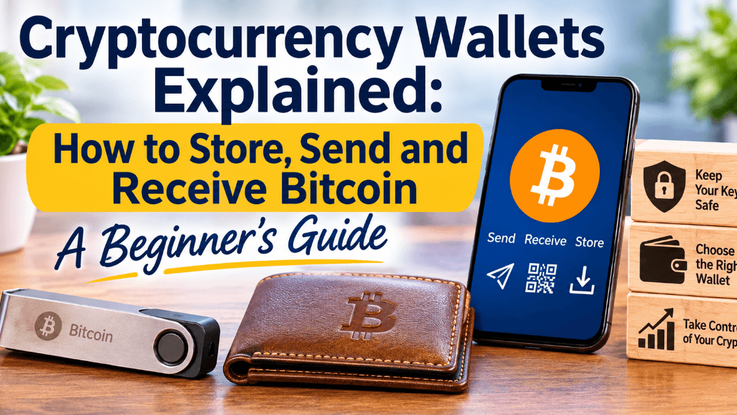
If you’re getting involved in cryptocurrency, one of the first things you’ll need to understand is how cryptocurrency wallets work.
You might have earned some Bitcoin through an online platform, purchased cryptocurrency through an exchange, or received a payment from somebody else. Whatever the reason, you’ll eventually need somewhere to store it and a way to send or receive it.
But cryptocurrency wallets aren’t quite like the physical wallets we’re accustomed to carrying around. There are different types, each with its own advantages and disadvantages, and understanding the differences can help you make better decisions about managing your digital assets.
I’ve been involved in cryptocurrency for many years, initially through Bitcoin, then Steem and Hive, and more recently through platforms such as Satsman and the Bitcoin Lightning Network. Along the way, I’ve used different services and wallets to move cryptocurrency between platforms.
In this guide, I’ll explain the essentials, including how cryptocurrency wallets work, the difference between exchange accounts and self-custody wallets, and how to send and receive Bitcoin.
1. What Is a Cryptocurrency Wallet?
A cryptocurrency wallet is a tool that allows you to access and manage your cryptocurrency.
Unlike a traditional wallet, it doesn’t actually contain physical coins or banknotes. Your cryptocurrency exists on its respective blockchain, which is a distributed digital ledger recording transactions.
Your wallet provides the means to interact with that blockchain.
Most cryptocurrency wallets work using two important components: public and private keys.
Public keys and wallet addresses
A public key is derived from a private key and can be used to generate cryptocurrency addresses. An address is what you generally share with someone who wants to send you cryptocurrency.
Think of it as something similar to your bank account number. Someone can use it to send you money, but knowing your address doesn’t give them control over your funds.
Private keys
Your private key is what gives you control over the cryptocurrency associated with it. It allows you to authorise transactions and move funds.
Many wallets use a recovery phrase, often consisting of 12 or 24 words, which can be used to restore access to your wallet if you lose your device.
This phrase is sometimes called a seed phrase.
Treat it like the keys to your safe. Anyone who obtains it may be able to access your cryptocurrency. Never share it with somebody claiming to be from a wallet provider, exchange or support department.
If you lose your recovery phrase and access to your wallet, recovering your funds may be impossible.
One important distinction: not every cryptocurrency service gives you control of your private keys. With a custodial service, the provider manages them on your behalf.
2. Exchange Wallets Versus Self-Custody Wallets
When you first acquire cryptocurrency, you may find that it is held in an account on an exchange or another online platform.
This is convenient, but it’s important to understand the difference between an exchange account and a wallet that you control yourself.
Exchange wallets
A cryptocurrency exchange allows you to buy, sell and sometimes hold different cryptocurrencies.
When you leave your cryptocurrency on an exchange, the exchange generally controls the private keys associated with your account. You can instruct the exchange to make transactions, but you don’t have direct control of the underlying keys.
The advantage is convenience. You can usually access your funds through a website or mobile application without having to manage private keys yourself.
The disadvantage is that you’re relying on the exchange to remain operational, secure and willing and able to process withdrawals.
Exchanges can experience technical problems, impose withdrawal restrictions or, in some circumstances, become insolvent.
Self-custody wallets
A self-custody wallet gives you control over your private keys.
Rather than relying on an exchange to manage your cryptocurrency, you take responsibility for securing your wallet and authorising transactions.
This offers greater independence, but it also means greater responsibility.
If you lose access to your wallet and don’t have a valid recovery phrase or backup, there may be no customer support department capable of restoring your funds.
For many cryptocurrency users, a combination of exchange accounts and self-custody wallets makes sense. Exchanges can be useful for buying and selling, while self-custody wallets provide greater control over cryptocurrency you intend to hold.
3. Different Types of Cryptocurrency Wallets
There are several different ways to store and access cryptocurrency. The most common options include the following.
Exchange accounts
These are custodial accounts provided by cryptocurrency exchanges.
They are generally straightforward to use and can be convenient for beginners who are purchasing cryptocurrency for the first time.
However, remember that you are relying on the exchange to safeguard your funds.
Mobile wallets
Mobile wallets are applications installed on your smartphone.
They allow you to send and receive cryptocurrency without needing to access a computer. Some support Bitcoin transactions, while others support multiple cryptocurrencies or particular blockchain networks.
Mobile wallets are particularly convenient for everyday transactions.
I’ve used mobile wallets as part of my own Bitcoin activities, including receiving Bitcoin through the Lightning Network.
Desktop wallets
Desktop wallets are installed on a computer and provide access to your cryptocurrency through dedicated software.
Depending on the wallet, you may have full control of your private keys and access to additional security features.
However, your computer needs to be protected against malware, unauthorised access and other security threats.
Hardware wallets
Hardware wallets are physical devices designed to keep private keys isolated from your everyday internet-connected devices.
They are often used by people holding larger amounts of cryptocurrency or those who intend to store digital assets over an extended period.
Transactions can be authorised using the hardware device without exposing the private keys directly to your computer.
The additional security can be worthwhile, although hardware wallets require some familiarity with their operation and recovery procedures.
There isn’t one universally best type of wallet. Your choice will depend on how frequently you use cryptocurrency, how much you hold and how comfortable you are managing your own security.
4. How to Send and Receive Bitcoin
Once you have a Bitcoin wallet, sending and receiving cryptocurrency is relatively straightforward.
However, there are a few important details to understand before making your first transaction.
Receiving Bitcoin
To receive Bitcoin, you generally need to provide the sender with your Bitcoin address.
This is a long string of letters and numbers, although most wallets also provide a QR code that can be scanned.
The sender uses this address to initiate the transaction.
It’s important to check that you’re using the correct address and network. Bitcoin addresses should only be used for transactions on the Bitcoin network. Don’t assume that an address for another cryptocurrency or blockchain is interchangeable.
Sending Bitcoin
To send Bitcoin, you’ll normally need:
- The recipient’s Bitcoin address.
- The amount you want to transfer.
- An appropriate transaction fee.
Your wallet will generally calculate or suggest a transaction fee, which can vary depending on network demand.
Always double-check the recipient’s address before confirming a transaction. Cryptocurrency transfers are generally irreversible, and sending funds to an incorrect address can result in permanent loss.
For larger amounts, it’s sensible to make a small test transaction first, where practical.
Bitcoin and the Lightning Network
There’s another development worth understanding if you’re using Bitcoin for smaller or more frequent transactions: the Lightning Network.
The Lightning Network is a payment system built on top of Bitcoin that allows transactions to take place through payment channels rather than recording every individual payment directly on the Bitcoin blockchain.
This can make payments considerably faster and cheaper than conventional on-chain Bitcoin transactions.
Instead of using a standard Bitcoin address, Lightning payments commonly use an invoice or, with supported services, a Lightning address.
It’s important to distinguish between the two.
A Bitcoin on-chain address and a Lightning invoice are not interchangeable. You need to use a wallet or service that supports the particular type of transaction you’re making.
5. My Own Experience: From Bitcoin Faucets to Lightning and Hive
My interest in cryptocurrency goes back further than you might imagine. I probably first became interested in Bitcoin around 2012, when it was still a relatively obscure technology that few people outside the early adopter community knew much about.
I remember reading a book about Bitcoin because I wanted to understand what this new technology was all about. The idea of a decentralised digital currency, operating without the involvement of traditional banks, fascinated me.
I eventually dipped my toes into the world of Bitcoin by using online faucets to accumulate small amounts of satoshis. I continued building up my modest Bitcoin stash over the years, both through faucets and, increasingly, through my affiliate marketing activities.
My involvement with Steem, and subsequently Hive, represented the next big step in that journey. These blockchain-based social networks introduced me to a different dimension of cryptocurrency, allowing users to publish content, interact with other members and earn blockchain rewards.
Bitcoin, however, remained part of my cryptocurrency activities throughout this period.
More recently, I’ve been exploring additional ways to earn and use Bitcoin, particularly through platforms that reward users for completing activities and participating in online communities.
One example is Satsman, where I’ve been earning Bitcoin through daily missions and other activities.
I’ve successfully withdrawn Bitcoin from Satsman using the Lightning Network, receiving the funds through a compatible wallet before transferring them onwards.
I’ve also explored how to convert Satsman Bitcoin earnings into HIVE – the cryptocurrency associated with the Hive blockchain.
This involves understanding the different networks and the services that facilitate transfers between them. Bitcoin and HIVE are separate cryptocurrencies operating on different blockchains, so you cannot simply send one directly to an address belonging to the other.
In my case, the process has provided a practical opportunity to learn more about Lightning payments, cryptocurrency withdrawals and moving funds between different blockchain ecosystems.
I’ve documented some of these experiences on my YouTube channel, including videos demonstrating successful Lightning withdrawals from Satsman.
The important lesson is that having a cryptocurrency wallet isn’t just about storing digital assets. It’s also about understanding how to move them safely between platforms and networks.
If you’re interested in exploring these subjects, you can find my videos and other online business and cryptocurrency content on my YouTube channel.
A Few Important Security Considerations
Before getting involved with cryptocurrency wallets, there are some basic precautions worth following.
Protect your recovery phrase. Never store your seed phrase somewhere that can easily be accessed by other people. Avoid taking screenshots or storing it in an unprotected cloud account.
Use strong passwords and two-factor authentication. Protect your exchange accounts and any other services that provide access to your cryptocurrency.
Check addresses carefully. Cryptocurrency transactions are generally irreversible. Always verify the recipient’s address before sending funds.
Beware of unsolicited messages. Scammers frequently impersonate wallet providers, exchanges and customer support representatives. Never disclose your private keys or recovery phrase.
Understand the network. Bitcoin, Ethereum and Hive operate on different blockchains. Even when services support several cryptocurrencies, you must select the correct network when making a transfer.
Don’t invest more than you can afford to lose. Cryptocurrency prices can be extremely volatile, and holding digital assets carries risks that are different from those associated with conventional bank accounts.
Final Thoughts
Cryptocurrency wallets are an essential part of participating in the digital asset economy.
Whether you’re buying Bitcoin, earning cryptocurrency through online activities, receiving payments or transferring funds between different blockchain networks, understanding how wallets work gives you greater control over your digital assets.
You don’t need to become a technical expert to get started. However, you should understand the difference between custodial and self-custody wallets, how private keys work and why choosing the correct network matters.
My own journey, beginning with Bitcoin faucets around 2012 and progressing through Steem, Hive and more recently Lightning withdrawals, has given me plenty of opportunities to explore these subjects in practice.
The technology continues to develop, but the underlying principles remain the same: understand what you’re using, protect your access credentials and take responsibility for the security of your cryptocurrency.
This article is for educational purposes only. It is not financial or investment advice, nor an endorsement of any particular cryptocurrency, exchange or wallet provider.



Leave a Reply